

The 26th China International Industry Fair (CIIF) opened on October 12 at the National Exhibition and Convention Center in Shanghai. Covering 310,000 m² with over 3,200 exhibitors, this year's show is 20.7 times and 7.8 times the size of the first fair in 1999, respectively. More than 400 Fortune Global 500 companies are participating, and over one-third of domestic exhibitors are "specialized, refined, differentiated and innovative" ("SRDI") "little giant" enterprises.
The scale numbers keep breaking records every year, but the answer to "what should I see at CIIF?" changes annually. The biggest difference this year: AI is no longer just a flashy demo on a booth-it has started actually working on the factory floor.

1. The "Brain Upgrade": AI Moves from Perception to Decision-Making

In past years, industrial AI was all about "perception"-teaching machines to "see" and "listen." This year's CIIF sends a clear signal: AI is moving into the factory's decision-making core.
Black Lake Technology brought an entire, previously invisible decision chain to the booth for the first time, showcasing over 10 decision-making industrial agents covering quotation, engineering, scheduling, order tracking, quality inspection, and warehouse management. Their engineering agent can complete drawing process analysis in about 1 minute with 95% accuracy. These agents don't work in isolation-judgments made during engineering flow into quotation and scheduling, and when orders or production conditions change, downstream steps adjust automatically.
JD Industrial's "Gongpin Zhilian" platform, built on the Joy Industrial large language model, packages materials governance and compliance review into 22 intelligent agent applications, improving data governance efficiency by 10x and lifting end-to-end task success rate from 60% to 90%.
On-site, Shanghai officially launched its "Next-Generation Intelligent Manufacturing Action," covering four major projects and 19 key tasks spanning supply-led innovation, "AI+Manufacturing" foundation, tiered smart factory cultivation, and ecosystem building.
What to look for: Not what AI can demo, but what it has already done on real production lines.
2. The "Hands and Feet": Robots That Actually Do the Work

If decision-making AI is the factory's brain, robots are its hands and feet. This year's robot hall takes up two full pavilions (7.1H and 8.1H), covering 56,000 m² and gathering 350+ leading domestic and international companies.
The "big four"-ABB, FANUC, KUKA, and Yaskawa-all debuted new annual products, while Chinese leaders like Siasun, Estun, and JAKA presented their latest indigenous technology. A major new Humanoid & Embodied Intelligence zone showcases bipedal humanoids, dexterous hands, and AI-embedded robots.
More tellingly, real-world deployment is accelerating:
- Siemens demonstrated its first end-to-end humanoid robot workflow, with a wheeled humanoid interacting in real time with a CNC machine to simulate machine loading/unloading.
- JAKA Robotics' wheeled humanoid is already working at a global auto parts giant's smart headlight factory; its new 50kg heavy-payload version debuted this year.
- Leju Robotics launched a "universal humanoid body + universal dexterous hand" solution with repeatability under 0.03mm and 24kg payload, already ordered by FAW, Hisense, and China Logistics.
What to look for: Not robots doing backflips, but which production line they're on, whose jobs they've taken over, and how much efficiency has improved.
3. The "Foundation": China's Chip Hall Debuts as a Separate Show
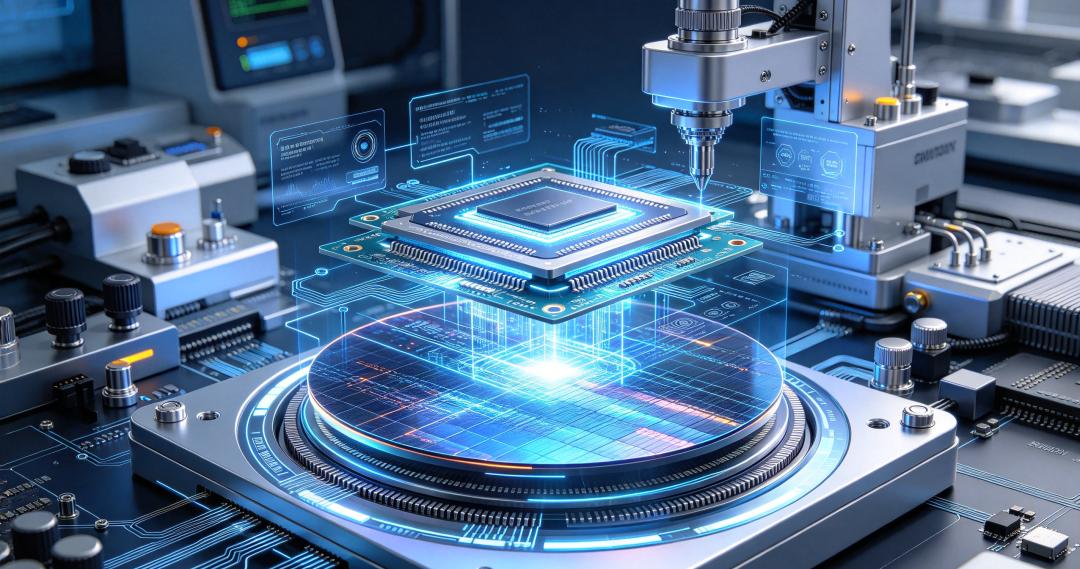
CIIF expanded from nine to ten exhibition zones this year. The most notable change is the integrated circuit (chip) exhibition becoming a standalone hall for the first time, covering the full chain from chip design, wafer fabrication, packaging/testing, and semiconductor equipment to core materials.
Over 300 companies exhibited, including Hua Hong-scale players, top-10 semiconductor equipment firms like AMEC, and top-10 materials firms like Zing Semiconductor. At the "nano" scale, AMEC's high-aspect-ratio etch equipment is domestically controlled and already running on leading-edge lines at international customers, with atomic-level precision.
Over 27 years, CIIF's evolution reflects Chinese manufacturing shifting from "equipment upgrades" to "system restructuring." The standalone chip hall signals that chips have moved from a "component" to a "foundation" that must be examined on its own.
What to look for: Not just chips themselves, but how far China's industrial self-controllability has come.
4. The "Flexibility": Production Lines That Adapt
"Next-gen smart manufacturing cares a lot about takt time-speed flexibility is critical," said Wei Ya, brand lead at Guoli Intelligent Manufacturing, on-site.
Guoli presented its fully in-house maglev intelligent flexible transport system, reaching 6 m/s top speed with 0.01 mm positioning accuracy-3x faster than traditional conveyors. Integrated with AI monitoring and predictive maintenance, it is already deployed at scale in lithium battery cell mid-process lines (winding/stacking, X-ray inspection, can insertion, tab welding).
At the CNC machine tool hall, Shanghai Electric Steam Turbine Works showed China's first flexible intelligent blade production line; at the next-gen smart manufacturing hall, Liulian Intelligent presented a full-stack AI-native PC factory. Over 800 exhibitors filled 80,000 m² under the "AI+Smart Machine Tool Full Chain" theme.
What to look for: Not how fast a single machine runs, but whether the whole line can adapt on the fly.
5. The "Five Extremes": Pushing Manufacturing to Its Limits
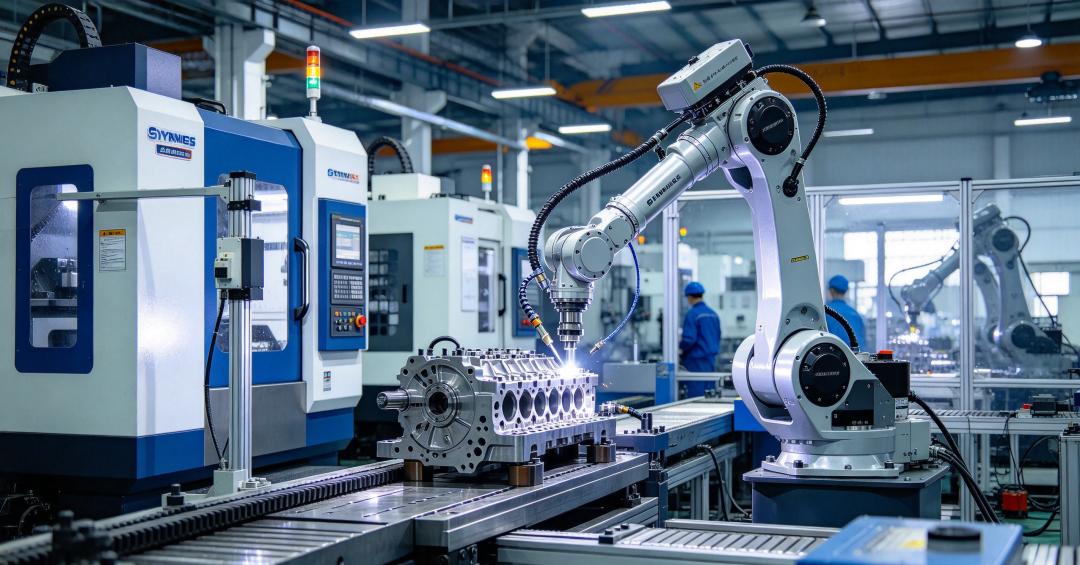
This year's show presented nearly 400 featured exhibits across five dimensions-extremely large, extremely small, extremely light, extremely precise, and extremely intelligent:
- Extremely large: Chaofu's heavy-payload industrial robot set a new Guinness World Record at 5,000.36 kg, with all three core components (RV reducer, servo motor, controller) domestically controlled.
- Extremely small: Chipmaking is like building a 50-story building at 1/10,000 the width of a human hair. AMEC's etch equipment represents China's breakthrough at this scale.
- Extremely precise: The "Hefit" system is China's first domestically developed nuclear-grade digital I&C system, making China the fourth country to master the technology. It controls hundreds of systems, tens of thousands of devices, and 26,000 signals in nuclear plants; paired with Hualong One 2.0, it raises automation by 66% and cuts cabinet count by ~40%.
- Extremely intelligent: The world's first "zero-human-experience" agent-based machine tool debuted, pushing production toward intelligent, autonomous operation.
What to look for: Where China's manufacturing ceiling sits, and which "chokepoint" bottlenecks have been broken.
So, What Should You Actually See?
After walking all ten halls, the answer comes back.
Every change at CIIF is a projection of shifting industrial logic. This year's expansion from nine to ten halls-the chip hall spinning off, the telecom hall upgrading to next-gen smart manufacturing-maps, from upstream materials to chip foundation to automation/robotics to end-use applications, a condensed version of China's industrial map.
China has now built over 56,000 basic-level, 9,000+ advanced-level, and 500+ excellent-level smart factories, plus 15 "lighthouse" smart factories.
As Haier Chairman Zhou Yunjie put it at the opening: "True manufacturing AI-ization isn't just stacking large models and bolting on smart apps-it's running AI deeply through R&D, procurement, production, supply chain, and service."
So what should you see at CIIF? The path of Chinese manufacturing moving from "point breakthroughs" to "system collaboration"-and that path is being walked, step by step. Across the 310,000 m² of halls, the answer isn't at any one booth-it's in the connections between them, in the industry chains being linked up.