


In the first half of 2026, the humanoid robot sector was at a fever pitch: Yushu Technology raised 4.2 billion yuan through its STAR Market IPO; UBTech's humanoid robot orders surpassed 13,000 units; Tesla's Optimus Gen 3 entered the mass production modification phase; and more than 140 domestic robot manufacturers rushed to launch products, with prototype demonstrations at trade shows coming one after another. Countless entrepreneurs and factory owners flooded into the sector, single-mindedly focused on independent R&D and assembly of complete robots.
However, looking beyond the bustling facade of the capital markets, a set of real industry data is enough to overturn conventional wisdom:
1. Of the 140 domestic humanoid robot manufacturers, fewer than five have achieved scalable profitability. UBTech's humanoid business generated 821 million yuan in revenue in 2025 but posted a net loss of 790 million yuan for the year; a large number of small and medium-sized manufacturers have revenues of less than 10 million yuan and continue to rely on funding infusions;
2. Orders for upstream manufacturers of gear reducers, six-axis force sensors, and integrated joints are generally booked through 2027. Ludi Harmonic, the leader in harmonic gear reducers, saw its 2025 revenue grow by 47% year-over-year, while component manufacturers' gross profit margins have remained stable at 40%–65%, completely unaffected by price wars in the robot assembly sector;
3. In the bill of materials (BOM) cost for a mass-produced humanoid robot, upstream core components account for 45%–70%, while robot integration, software, and assembly account for only 10%–15%, meaning profits in the supply chain are naturally concentrated upstream.
There is a widely held consensus in the capital markets: in the humanoid robot sector, the finished-product market is a game of competition, while the supply chain represents the real opportunity. The finished-product market is a race to burn cash, compete on use cases, and build brands; in the future, 90% of small and medium-sized manufacturers will be weeded out by industry consolidation. The upstream supply chain, however, is driven by precision manufacturing, technological barriers, and domestic substitution. As long as industry shipment volumes continue to grow, upstream suppliers will continue to benefit, with their certainty of returns far surpassing that of the finished-product market.
This article will thoroughly analyze-from five key dimensions: profit distribution across the industry chain, systemic risks in the finished-product sector, the order dynamics of the supply chain, four high-value sub-sectors, and practical implementation strategies-and backed by authoritative quantitative data, why the greatest opportunity in the humanoid robotics sector lies not in finished products, but in the supply chain.

An immutable law of manufacturing: High-value-added segments are concentrated in upstream raw materials and core components, which are characterized by technological barriers; midstream assembly and integration, on the other hand, feature low entry barriers, intense competition, and continuously squeezed profit margins. Humanoid robots perfectly mirror this pattern.
1. Quantitative Breakdown of the Complete Unit's BOM Costs:
Over 60% of funds flow to the upstream supply chain
Based on teardown reports of the Tesla Optimus and Yushu G1 mass-production models (China Post Securities, SemiAnalysis, and Morgan Stanley's 2026 research report), the percentage breakdown of hardware costs for mainstream humanoid robots falls within the following range:
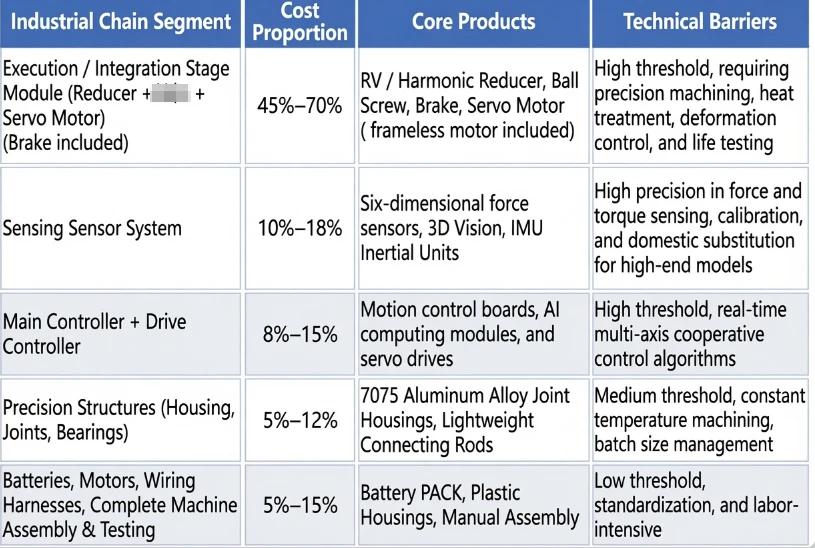
2. A Huge Gap in Gross Profit Margins:
Upstream components have high gross profit margins of 40%–70%,
while finished products generally have margins of 10%–20%, with most continuing to operate at a loss.
(1) Average Gross Profit Margin in the Upstream Core Components Industry
① Harmonic Reducers: 40%–55%. After Ludi's harmonic reducers replaced Japanese-made Harmonic Drive products, their price is only half that of Japanese-made Harmonic Drive products, yet the gross profit margin remains stable at over 42%;
② RV Heavy-Duty Reducers: 45%–60%. The localization rate is less than 25%; high-end products are in short supply, and pricing power lies entirely with manufacturers;
③ Planetary Roller Screws: 50%–70%. The current localization rate is only 40%–50%. These are essential components for Tesla's Optimus; import unit prices range from $1,350 to $2,700, leaving significant room for domestic substitution;
④ Six-axis force sensors: 50%–70%; the unit price for imports will be 20,000–30,000 yuan in 2025, but leading domestic manufacturers will reduce this to 5,000–8,000 yuan by 2026-a 60% cost reduction-while still maintaining ample gross profit margins;
⑤ Frameless torque motors: 35%–50%; localization rate exceeds 85%; leading manufacturers have their order books fully booked for the entire year, with both volume and prices rising;
⑥ Precision joint structural components (machining support): 25%–40%; entry barriers are lower than for transmission components, but they benefit from high demand and stable delivery cycles, making them the optimal entry point for small and medium-sized machining factories.
(2) Current Profitability of Humanoid Robot Manufacturers
① Companies that integrate fully outsourced components: The industry's average gross margin is only 10%–20%, with nearly all companies operating at a loss. Take UBTech as an example: in 2025, its humanoid robot revenue was 821 million yuan, with a gross margin of 18.6% and a net loss of 790 million yuan for the year; a large number of small and medium-sized robot manufacturers have gross margins below 12% and continue to bleed cash after deducting R&D, sales, and inventory depreciation.
② Leading robot manufacturers with in-house R&D and production of core components (Yushu Technology): Gross profit margin is 60.1%, but profits stem from self-developed upstream components such as gearboxes, motors, and lead screws; the gross profit margin for pure assembly operations is less than 18%. Of the company's 4.2 billion yuan raised through its IPO, 2.0 billion yuan was allocated to expanding component production lines rather than robot assembly lines, indirectly confirming that upstream components are the core of profitability.
③ Tesla's Optimus overseas: Currently in the small-batch pilot production phase, the gross profit margin for the complete robot is negative, with robot R&D subsidized by revenue from the complete vehicle business; positive profitability is only expected once large-scale in-house production of upstream components is achieved.
3. Pricing power lies entirely with upstream suppliers,
and finished products are caught in a never-ending price war.
① Supply shortages of scarce upstream components give manufacturers control over pricing and delivery times: The global production capacity of Japanese-made Harmonic Drive harmonic reducers is only 3.47 million units per year, with a delivery cycle of 3–6 months. Even as domestic substitution accelerates, high-end models remain in short supply. Component manufacturers can adjust prices in tiers based on order volume, eliminating the need to passively lower prices to win orders;
② The robot system market is extremely crowded, and price wars continue to squeeze profits: There are over 320 registered humanoid robot manufacturers in China, producing more than 330 mass-produced models, resulting in severe product homogenization. To secure pilot orders from factories, manufacturers are constantly cutting prices; some industrial humanoid robot models have seen price reductions of 30% within a year. Profits on robot systems continue to be eroded, and manufacturers without the capability to independently develop core components have no room to negotiate prices.

Many entrepreneurs and business owners only see the glamour of smartphone launch events, overlooking the irreversible industry risks behind the scenes. Four major shortcomings directly prevent the smartphone market from producing stable, profitable mainstream players:
Weakness 1: Heavy asset base, high R&D expenses, and high inventory,
resulting in long-term pressure on cash flow
1. A Bottomless Pit of R&D Expenditures: Humanoid robots require multi-pronged R&D efforts spanning hardware architecture, servo control, embodied large language models, and real-world deployment. Leading companies invest around 1 billion yuan annually in R&D, while small and medium-sized manufacturers spend tens of millions of yuan each year-a continuous drain on cash reserves. In the first five months of 2026, the domestic humanoid robot sector raised 46 billion yuan in funding, with over 40% of those funds consumed by R&D and stockpiling finished units.
2. Stockpiling finished units ties up massive amounts of working capital: The material cost for a single humanoid robot ranges from 100,000 to 150,000 yuan. Companies stockpile units in the tens of thousands, with inventory tying up over 1 billion yuan in capital; moreover, product models evolve extremely rapidly, posing a significant risk of inventory depreciation.
3. Channel and deployment costs are extremely high: B2B factory applications require on-site commissioning, after-sales service, and maintenance; the B2C consumer market requires brick-and-mortar stores and brand marketing, further eroding profits.
4. In contrast, upstream component manufacturers: Standardized products can be reused across models and brands; depreciation costs are lower due to bulk procurement; and there is no need to invest heavily in algorithm R&D, resulting in significantly better cash flow than that of robot manufacturers.
Weakness 2: Technology iteration cycles of 3–6 months,
rapid depreciation of finished product inventory, and extremely high component interchangeability
The joint parameters, overall structure, and AI algorithms of humanoid robots undergo iterations every 3–6 months. Older models become functionally obsolete and difficult to resell, leaving manufacturers with no choice but to sell them at a discount. According to GGII research data, the discount rate for older models after an iteration exceeds 40%, and excess inventory directly results in significant asset impairments.
In contrast, reducers, lead screws, motors, and sensors are standardized components that are compatible with both new and older models, posing an extremely low risk of inventory depreciation. Manufacturers can maintain long-term inventory and deliver in batches, avoiding the critical issue of entire units becoming "obsolete" due to product iterations.
Challenge 3: The commercialization process takes a long time,
demand is highly uncertain, and it is difficult to achieve scalable profitability in the short term
1. Shipment Forecasts Indicate the Industry Is Still in Its Early Stages: In its latest research report dated June 2026, Morgan Stanley raised its full-year shipment forecast for domestic humanoid robots to 50,000 units. However, the industry's break-even threshold is 100,000 units per year, and with global shipments in 2026 projected at only 50,000–62,500 units, the industry as a whole remains unprofitable;
2. Deployment progress falls short of expectations: Currently, only a few industrial applications-such as 3C assembly and power line inspections-have been stably implemented; commercialization in household and general service scenarios is at least 3–5 years behind schedule. For 74% of manufacturing clients, procurement resistance stems from insufficient robotic operational capabilities, resulting in significant uncertainty regarding order growth;
3. Revenue from complete robot systems is highly dependent on a single customer or a single project: If pilot projects at leading factories are terminated or procurement budgets are reduced, the revenue of robot system manufacturers is immediately cut in half; component suppliers, however, can supply dozens of robot system manufacturers simultaneously, thereby diversifying the risk associated with reliance on a single customer.
Weakness 4: The market is extremely crowded; a major industry shakeout is expected within 3–5 years, and 90% of small and medium-sized original equipment manufacturers will be eliminated.
Ministry of Industry and Information Technology (MIIT) 2026 Industry Monitoring Data: There are over 140 domestic companies involved in humanoid robot manufacturing, but only 5 have achieved stable mass production and positive operating cash flow; among more than 320 registered companies in the sector, 80% remain at the prototype stage, lacking mature mass production lines and stable downstream orders.
Industry Consensus: Over the next 3–5 years, only 3–5 leading global robot manufacturers will survive and achieve long-term profitability; the remaining small and medium-sized manufacturers will be acquired or eliminated due to cash flow shortages, technological lag, and insufficient orders. In contrast, the upstream component segments feature high entry barriers and few players, with each niche capable of producing multiple "hidden champions," resulting in a more stable competitive landscape.


The complete industrial process for humanoid robots: project initiation and R&D for the complete unit → procurement of components for prototypes → small-batch trial production and bulk procurement → large-scale mass production and ongoing repeat purchases. As soon as a robot manufacturer begins R&D, upstream component suppliers immediately receive orders; however, it takes at least 1–3 years for a robot to progress from the prototype stage to stable shipments, generate revenue, and become profitable.
With 2026 marking the first year of mass production, companies specializing in gearboxes, lead screws, and sensors have their order books filled for the entire year, and their financial results have already materialized; however, most system manufacturers are still in the capacity ramp-up phase and operating at a loss.
A manufacturer of harmonic reducers and six-axis force sensors supplies dozens of domestic and international OEMs, including Tesla, Yushu, UBTech, Zhiyuan, Xiaomi, and Huawei. Even if a single OEM cancels an order or faces operational difficulties, the component manufacturer can fully offset the loss with orders from its other customers.
In contrast, for original equipment manufacturers, their own products are their sole source of revenue. With a single customer base and limited application scenarios, they face the immediate risk of their revenue dropping to zero if their products lack competitiveness.
The Ministry of Industry and Information Technology's 2026 Humanoid Robot Special Program sets a clear target: to increase the localization rate of core components to 80% by the end of 2026. Currently, there is significant room for domestic substitution across various segments:
· Localization rate of RV heavy-duty reducers is <25%;
· Localization rate of six-axis force sensors is <30%;
· Localization rate for planetary roller screws: 40%–50%; As domestic manufacturers replace imports, they are steadily capturing market share from Japanese, European, and American competitors. The industry's growth is driven by two factors: increased humanoid robot shipments and a rising share of import substitution, with both factors driving upward performance.

Track 1: Precision Transmission Systems
(Gearboxes + Planetary Roller Screws-the highest value and strongest barriers to entry)
A single humanoid robot is equipped with 14–30 harmonic/RV reducers and 14 planetary roller screws, which together account for 30%–45% of the robot's total BOM cost; by 2030, the global market size for transmission components is projected to exceed 100 billion yuan, with a compound annual growth rate of 106% from 2025 to 2030 (Morgan Stanley).
Current Status of Localization
1. Harmonic reducers: The localization rate is 60%–70%, and a domestic duopoly has taken shape. Ludi Harmonic's revenue is projected to grow by 47% year-over-year in 2025, with orders booked through 2027;
2. Heavy-duty RV reducers: The localization rate is less than 25%, and the high-end market remains monopolized by Japan's Nabtesco, presenting the greatest potential for substitution;
3. Planetary roller screws: Essential components for Optimus; localization rate is 40%–50%; import unit prices are 2–3 times those of domestic products, leaving ample room for price reductions through domestic substitution.
Technical Barriers
Micrometer-level gear tooth machining, heat treatment deformation control, and tens of thousands of hours of lifespan testing require specialized five-axis gear grinding equipment, temperature-controlled workshops, and gear inspection centers, making this a high-barrier upstream sector.
Track 2: Servo Actuator Motors
(Frameless Torque / Hollow-Shaft Motors, with the Highest Likelihood of Mass Production)
Key Data
Each unit is equipped with 30–60 micro motors, accounting for 12%–20% of the unit's total cost; the localization rate for frameless torque motors in China has exceeded 85%, making it the most mature segment in the upstream supply chain; leading manufacturer Mingzhi Electric's revenue from humanoid motors grew by 380% year-over-year.
Advantages
Domestic substitution has been fully achieved in the mid-to-low-end segments, while production capacity for high-end humanoid-specific motors continues to expand. Orders are stable, delivery cycles are manageable, and gross profit margins remain steady at 35%–50%, with risks significantly lower than those associated with transmission components.
Track 3: Six-Axis Force / Tactile Sensors
(The largest blue ocean for domestic substitution, with the highest growth potential)
Key Data
Each humanoid robot is equipped with 8–12 six-axis force sensors. In 2025, the unit price for imported sensors was 20,000–30,000 yuan; by 2026, leading domestic manufacturers had reduced this to 5,000–8,000 yuan-a drop of over 60% within a year. Currently, the domestic production rate is less than 30%, indicating significant room for substitution over the next three years, with the industry projected to grow at a rate exceeding 120% annually.
Industry Logic
Force sensors are the core sensing components that enable humanoid robots to perform flexible grasping and balanced walking; they are essential for both industrial and household applications. Previously monopolized for a long time by overseas companies such as ATI and Futek, they represent a critical bottleneck in the supply chain. With strong policy support, the market offers vast room for growth.
Track 4: Precision Structural Parts Machining
(The only low-barrier-to-entry track for small and medium-sized machining shops; the top choice for launching a manufacturing business)
Key Data
The weight of metal structural components for a single humanoid robot (thin-walled joint housings, linkages, motor mounts, and dexterous hand housings) ranges from 10 to 18 kg, accounting for 5% to 12% of the total BOM cost; by 2030, the global market size for the machining of humanoid structural components is projected to exceed 20 billion yuan, making it well-suited for the transformation of existing CNC precision machining factories in the Yangtze River Delta and Pearl River Delta regions to supply this sector.
Tiered Entry Pathways (No Major R&D Investment Required; Light-Asset, Feasible Implementation)
1. Entry Level (Low Investment): Bases, outer casings, and standard motor housings, with tolerances of ±0.03–0.05 mm; can be processed using three-axis or basic five-axis machines;
2. Intermediate Tier (Moderate Investment): 1.2 mm thin-walled joint housings, requiring single-setup five-axis machining at a constant temperature of 22 ± 1°C, significantly increasing added value;
3. High-Value Tier (Capital-Intensive): Reducer rigid gears, flexible gears, and lead screw bases, with micron-level tolerances, requiring high-end grinding machines and a complete coordinate measuring machine (CMM) inspection system.
Advantages Compared to Complete Machine Manufacturers
No need to develop algorithms, set up complete machine production lines, or bear the risks of end-user after-sales service and inventory; as long as you possess precision CNC machining capabilities, you can enter the upstream supply chain. Regardless of which complete machine manufacturer ships products, they all need to procure metal structural components, and this opportunity will continue for 5–10 years.