
Yo, what's up! As a supplier of harmonic drive components, I've been getting a lot of questions about the inertia of these components. So, I thought I'd write this blog to break it down for you.
First off, let's talk about what harmonic drive components are. They're a type of gear system that use a flexible spline and a wave generator to transmit motion. These components are super popular in robotics, aerospace, and other high - precision applications because they offer high torque transmission, compact size, and high reduction ratios.


Now, onto the main topic: inertia. Inertia is basically an object's resistance to changes in its state of motion. In the context of harmonic drive components, it plays a crucial role in how the system behaves.
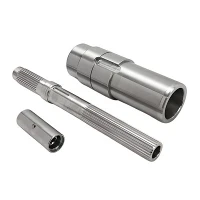
When it comes to the inertia of harmonic drive components, there are a few key parts to consider. Let's start with the Robot Reducer Hollow Shaft. The hollow shaft is an important part of the harmonic drive system. Its inertia affects how quickly the system can start and stop. A lower inertia in the hollow shaft means that the system can respond more quickly to changes in speed or direction. This is especially important in applications where rapid movements are required, like in robotic arms.
Next, we have the Output Bearing. The output bearing is responsible for supporting the load and allowing smooth rotation. The inertia of the output bearing can impact the overall performance of the harmonic drive. If the inertia of the output bearing is too high, it can cause the system to be sluggish and less responsive. On the other hand, a well - designed output bearing with an appropriate inertia can improve the efficiency and accuracy of the system.
Another critical component is the Wave Generator Bearing. The wave generator bearing is what creates the wave motion in the flexible spline. Its inertia affects the smoothness of the wave generation. A lower inertia in the wave generator bearing can lead to a more precise and efficient wave motion, which in turn improves the overall performance of the harmonic drive.
Calculating the inertia of these components is not always straightforward. It depends on factors like the material of the component, its shape, and its size. For example, if a component is made of a denser material, it will generally have a higher inertia. Similarly, a larger component will also have a higher inertia compared to a smaller one of the same material.
In practical applications, understanding the inertia of harmonic drive components is essential for optimizing the performance of the system. For instance, in a robotic application, if the inertia of the components is not properly balanced, it can lead to issues like vibrations, inaccuracies in positioning, and even premature wear and tear of the components.
Let's take a look at an example. Suppose you're designing a robotic arm for a pick - and - place application. You need the arm to move quickly and accurately. By choosing harmonic drive components with the right inertia, you can ensure that the arm can start and stop rapidly, and that it can position the objects precisely. If the inertia of the components is too high, the arm will be slow to respond, and it may not be able to achieve the required level of accuracy.
Now, as a supplier of harmonic drive components, I know how important it is to provide high - quality components with the right inertia characteristics. We've spent a lot of time researching and developing our products to ensure that they meet the needs of our customers. Whether you're working on a small - scale robotic project or a large - scale industrial application, we've got the right harmonic drive components for you.
If you're in the market for harmonic drive components, I'd love to have a chat with you. We can discuss your specific requirements and help you choose the components that are best suited for your application. Don't hesitate to reach out and start a conversation about your procurement needs.
In conclusion, the inertia of harmonic drive components is a critical factor that affects the performance of the entire system. By understanding how inertia works and choosing the right components, you can optimize the performance of your application. Whether it's for robotics, aerospace, or any other high - precision field, the right harmonic drive components with the appropriate inertia can make a big difference. So, if you're looking for top - notch harmonic drive components, get in touch with us, and let's work together to find the perfect solution for you.
References
- Various engineering textbooks on mechanical design and robotics
- Industry research papers on harmonic drive systems